
Table of Contents
1.The Classic Contenders: A Quick Introduction
2.The Case for Test Strips: Convenience Meets Modern Technology
3.The Case for Liquid Kits: The Traditional Gold Standard
4.Head-to-Head Comparison: A Visual Breakdown
5.The Game Changer: Digital Readers and Industry Standards
6.The Final Verdict for Your Outdoor Spa
The Classic Contenders: A Quick Introduction
Before we dissect their accuracy, let's briefly define our two contenders.
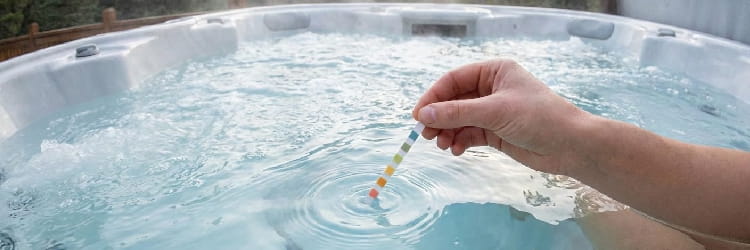
Test Strips: These are small strips of paper or plastic with several colored pads on them. Each pad is impregnated with chemical reagents that react to specific elements in your hot tub water (like chlorine/bromine, pH, Total Alkalinity, etc.). You dip the strip, wait a few seconds, and compare the resulting colors to a chart on the bottle .
Liquid Test Kits: These kits, often called reagent kits, involve taking a sample of your hot tub water in a small vial. You then add a specific number of drops of a chemical reagent, cap the vial, mix, and watch for a color change . The resulting color is compared to a printed color scale to determine the chemical level . Some tests, like for calcium hardness, are "titration" tests, where you count drops until the water changes to a specific color .
Now, let's explore the strengths and weaknesses of each.
The Case for Test Strips: Convenience Meets Modern Technology
For years, test strips were often dismissed by professionals as being less accurate. However, significant technological advancements have challenged this old notion .
The Undeniable Advantage: Speed and Simplicity
The number one reason people love test strips is their ease of use. The process is incredibly straightforward and fast, often providing a full spectrum of results in under a minute . There's no measuring water samples, no counting drops, and no cleaning vials afterward . For the busy hot tub owner who wants a quick, regular snapshot of their water health, the convenience is unparalleled . Their small size also makes them highly portable and easy to store .
The Accuracy Question: Have They Caught Up?
Here's the core of the debate. While early generations of test strips may have deserved their reputation for inconsistency, the technology has evolved dramatically. Many modern, high-quality test strips now offer accuracy that is comparable to, and in some practical scenarios even better than, liquid test kits .
Recent advancements in chemical indicators and manufacturing processes have led to more stable and reliable color pads . Some sources now argue that a quality test strip, used correctly, can be just as, if not more, accurate for the average user because it eliminates many of the potential user errors inherent in liquid kits .
Potential Pitfalls: Where Strips Can Go Wrong
Despite these improvements, test strips are not foolproof. Their accuracy is highly dependent on proper usage and storage.
Subjective Color Matching: The biggest variable is you. Interpreting the color on the pad and matching it to the chart can be subjective. Poor lighting, individual color perception differences, or trying to guess a color that falls "in-between" two shades can lead to inaccurate readings .
Sensitivity to Environment: Test strips are highly sensitive to heat and moisture . Grabbing a strip with wet fingers or leaving the container open in a humid environment can contaminate the entire batch and ruin their accuracy.
Expiration and Quality: Not all strips are created equal. Quality can vary between brands and even between batches . Furthermore, they have a limited shelf life, typically around one year, and using expired strips will yield unreliable results .

The Case for Liquid Kits: The Traditional Gold Standard
Liquid test kits have long been the choice of pool and spa professionals, prized for their perceived higher level of precision.
The Promise of Pinpoint Precision
The primary argument for liquid kits is their potential for greater accuracy. Instead of matching a broad color range, you're often matching a solid color in a vial, which can be less ambiguous . Titration tests, in particular, can provide more specific numerical results rather than a range, which is why they are often considered the most accurate method for home testing of certain parameters like calcium hardness and total alkalinity . Historically and among many industry veterans, they are still seen as the benchmark for reliability .
The Human Factor: Where Precision Can Falter
The greatest strength of liquid kits—their precision—is also their greatest weakness. Their accuracy is entirely contingent on the user performing the test perfectly. There are numerous points where a simple mistake can skew the results:
Incorrect Sample Size: Not filling the vial to the exact line.
Incorrect Reagent Amount: Adding too many or too few drops, or not holding the bottle perfectly vertical, which can alter drop size .
Improper Timing: Not waiting for the specified amount of time for the color to develop.
Contamination: Using a dirty vial or cap from a previous test.
Because the process is more complex and has more steps, the potential for user error is significantly higher compared to test strips .
The Commitment: Time, Steps, and Cost
Compared to the 30-second test strip process, using a liquid kit is a more involved procedure that can take several minutes. It requires careful attention to detail and is less convenient for quick checks . While the kits themselves can last for several years if stored properly the initial purchase price is often higher than a bottle of test strips .
Head-to-Head Comparison: A Visual Breakdown
To make things clearer, let’s summarize the key differences in a table.
Feature | Test Strips | Liquid Test Kits |
Accuracy Potential | Good to Excellent (with modern, high-quality strips) | Excellent (when performed correctly) |
Ease of Use | Very Easy (Dip and read) | Moderate to Difficult (Requires measuring, counting drops, timing) |
Speed | Very Fast (Under 1 minute) | Slower (Several minutes per test) |
Cost | Generally lower initial cost | Generally higher initial cost, but can be cost-effective long-term |
Potential User Error | High (Subjective color matching, improper storage) | Very High (Incorrect sample size, drop count, timing, contamination) |
Parameters Tested | Typically tests 4-7 key parameters at once. | Often requires separate tests for each parameter. |
The Game Changer: Digital Readers and Industry Standards
The debate is no longer just a two-way race. A third option has emerged that combines the best of both worlds: digital water testers.
These handheld electronic devices use a test strip (or sometimes a reagent) but eliminate the biggest source of error: human color perception. You dip the strip as usual, but instead of comparing it to a chart, you insert it into the digital reader. The device uses a photometer to analyze the color with scientific precision and gives you a clear, numerical reading on an LCD screen . This innovation provides the convenience of a test strip with accuracy that can meet or exceed that of a liquid kit .
Furthermore, for those seeking the highest level of confidence, it's worth knowing about industry standards like NSF/ANSI 50. This standard certifies equipment and chemicals for pools, spas, and hot tubs . When a water testing product is NSF certified, it has been independently evaluated for performance, accuracy, and operational range . These certified products are often given an accuracy rating (like L1 for highest precision), providing an extra layer of assurance that you're using a reliable tool .

The Final Verdict for Your Outdoor Spa
So, after weighing all the evidence, which method is more reliable for your hot tub?
As of 2026, the answer is: the most reliable test method is the one you will use consistently and correctly.
The old belief that liquid kits are inherently superior is outdated. Technology has leveled the playing field, and user error is now the single biggest factor affecting accuracy for both methods.
Here is our final recommendation:
For the everyday hot tub owner seeking convenience: A high-quality, modern test strip from a reputable source is an excellent and sufficiently accurate choice for regular maintenance. Store them properly and use them before they expire, and you will keep your outdoor tub in great shape.
For the data-driven owner or when troubleshooting a problem: A liquid titration kit can provide the specific, numerical data you need to zero in on issues with calcium hardness or alkalinity. Using both—strips for daily checks and a liquid kit for a weekly deep dive—is a fantastic strategy.
For the owner who wants the best of both worlds: Investing in a digital water tester is the ultimate solution. It combines the speed and simplicity of strips with lab-grade precision, removing any guesswork from maintaining your outdoor spa.
Ultimately, maintaining a clean, safe, and sparkling hot tub is about consistency. Choose the testing method that fits your lifestyle and budget, follow the instructions meticulously, and you'll be able to relax and enjoy every soak with peace of mind.