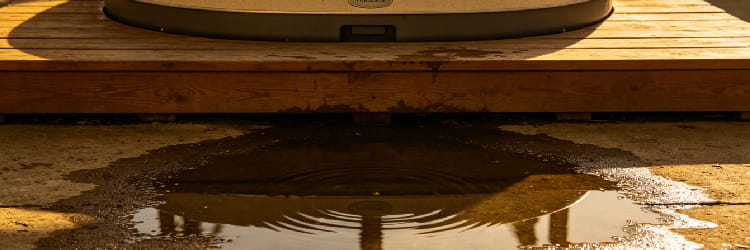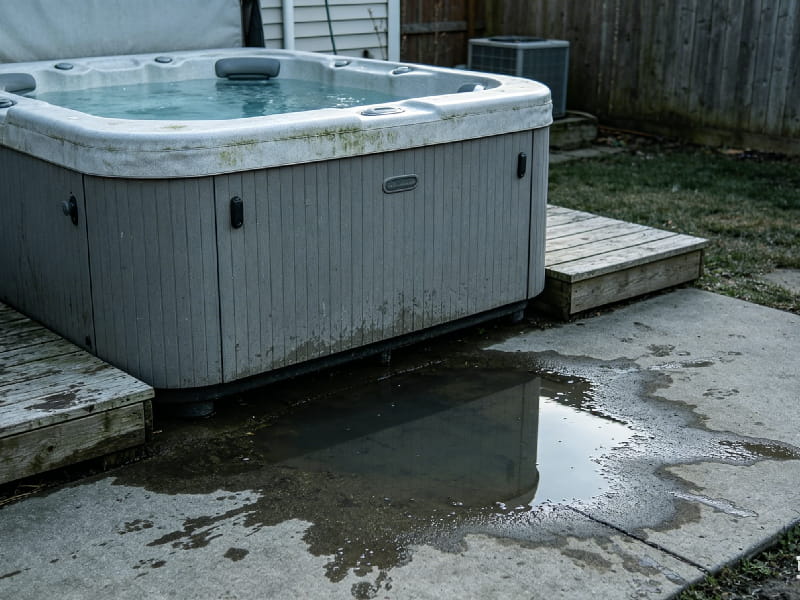
So, you’ve just stepped outside, ready for a blissful soak, only to be greeted by a sight of pure horror: a mysterious puddle forming beneath your beloved hot tub. Your oasis of relaxation is suddenly a source of stress, looking less like a luxury spa and more like it's having a very public, very wet emotional breakdown. If you've discovered your hot tub leaking water from bottom, take a deep breath. Don't panic-sell it for parts just yet.
You, my friend, are about to become a Leak Detective. Forget Sherlock Holmes; your tools are a keen eye, a bit of food coloring, and this trusty guide. We're going to turn your panic into power and transform that "Oh no!" into an "Aha! Gotcha!" We’ll cover the professional-level tricks, like the famous dye test, and zoom in on the most common culprits: those pesky unions and pump seals.
Let's get that spa back to being a happy, self-contained body of water.
Blog Directory
1.Channel Your Inner Detective: The Art of Leak Detection
2.Rounding Up the Usual Suspects: Where Leaks Love to Hide
3.The DIY Hall of Shame: Hilarious Mistakes to Avoid
4.You've Got This! (Or You Know Who to Call)
1.Channel Your Inner Detective: The Art of Leak Detection
Before we start tearing panels off like a DIY superhero, we need a plan. The first rule of leak detection is to work smart, not hard. The question of how to find spa leak is less about brute force and more about clever observation.
Step 1: The Pre-Flight Safety Check & Visual Stakeout
First things first: safety. Your hot tub is a wonderful marriage of water and electricity. Let's not turn it into a shocking experience. Before you do anything else, head to your circuit breaker and shut off all power to the spa . This is non-negotiable.
With the power off, you can begin your investigation.
1.Expose the Evidence: Remove the access panel to the equipment bay. This is usually on the side where your control panel is located.
2.Use Your Senses: Get a flashlight and get looking. You're searching for the obvious signs:
l Dripping water
l Puddles or standing water inside the cabinet
l White, chalky residue left behind by evaporated, chemically-treated water
l Wet insulation
Follow the water trail. Gravity is your friend here; water flows downhill. Trace any wetness back to its highest point. You might get lucky and spot a drip coming directly from a pipe fitting or the heater assembly. This initial visual inspection solves a surprising number of leak mysteries .
Step 2: The Dye Test - AKA The "Gotcha!" Moment
If the visual inspection leaves you stumped, it's time to bring in the secret weapon: the dye test. This technique is brilliant in its simplicity and is exactly what the pros use. The idea is to introduce a small amount of colored dye into the water and watch to see if it gets sucked into a crack or a bad seal .
Here's how to perform this piece of diagnostic magic:
l Turn Off the Chaos: Ensure the pumps and jets are completely off. You need the water to be as still as possible for this to work .
l Choose Your Weapon: You don't need a fancy kit. A few drops of dark-colored food coloring (blue or green works best) are perfect . Avoid red unless you want your tub to look like the set of a B-list horror movie.
l Get Close to Your Suspect: Identify a potential leak area, like a jet, a light fitting, or the filter housing.
l Release the Dye: Using a dropper or just carefully squeezing the bottle, release a small cloud of dye into the water about an inch away from your suspected leak point .
l Watch and Wait:
l If there is no leak, the dye will hover in the water or slowly dissipate.
l If there IS a leak, you will see the dye get pulled in a clear stream right into the crack or failing seal . It's an incredibly satisfying "Gotcha!" moment.
Go around and test each jet and fitting one by one. Leaks can be shy, and sometimes there's more than one, so be thorough in your investigation .
2.Rounding Up the Usual Suspects: Where Leaks Love to Hide
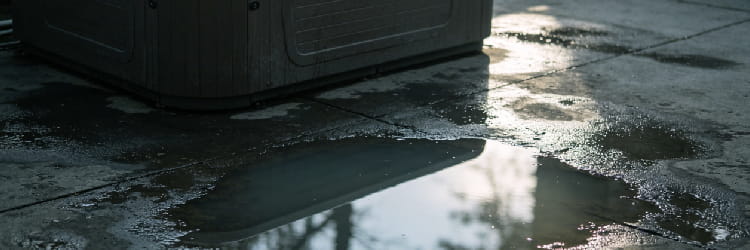
While a leak can technically spring from anywhere, 90% of the time, it's one of a few common culprits. It’s rarely a dramatic crack in the main shell. More often, it's a simple plumbing part that's just had enough .
The Case of the Loose Union: A Simple Twist of Fate
Unions are the large threaded connectors that join the plumbing pipes to the pump, heater, and other main components. The constant vibration from the pumps can sometimes cause them to loosen over time.
l How to Spot It: During your visual inspection, feel around these large plastic nuts. Are they damp? Do you see a slow drip coming from the connection point ?
l The Fix: This is often the easiest fix in the hot tub world. Before you reach for a giant wrench, STOP. These are plastic parts. Try tightening them by hand first. Grab both sides of the union and give it a firm "righty-tighty" twist . Often, a quarter-turn is all it needs.
l The Golden Rule: Do not use a channel lock or wrench unless you absolutely have to, and even then, be gentle! Overtightening can crack the plastic, turning a tiny leak into a very expensive plumbing disaster . If hand-tightening doesn't stop the leak, you may need to unscrew it completely (after draining the tub) and check the rubber O-ring inside for damage. A new O-ring often solves the problem .
The Weeping Pump Seal: When Your Hot Tub's Heart Aches
Think of the pump as the heart of your hot tub. The part that leaks is the shaft seal. Its job is to keep water in the "wet end" of the pump from getting into the "dry end" where the electric motor lives. When this seal fails, water begins to drip out.
l How to Spot It: This leak has a very specific signature. You will see water dripping from the body of the pump, right between the wet end (the part the pipes connect to) and the motor itself . If you see water coming from this specific spot, you've likely found your problem.
l The Fix: This is where we graduate from "easy DIY" to "intermediate-to-advanced." Learning how to fix hot tub seal components involves a bit more work. The repair requires draining the tub, removing the pump, taking the pump apart, and replacing the two-part seal assembly .
It's a completely doable job if you're mechanically inclined, but it requires patience and the correct replacement part. For many owners, a weeping pump seal is the perfect time to make a new friend: your local spa technician . There's no shame in calling for backup when you're about to perform open-heart surgery on your spa.
3.The DIY Hall of Shame: Hilarious Mistakes to Avoid
In the spirit of learning, let's look at a few common blunders that DIY detectives make. Avoid these, and you'll save yourself a headache and a much larger repair bill.
l The "Gorilla Grip" Maneuver: This is where a well-intentioned owner takes a giant wrench to a plastic plumbing union, inspired by the "There I Fixed It" meme . Remember, these are plastic parts, not the lug nuts on a monster truck. Overtightening will crack them every time . Rule of thumb: Hand-tight is the right tight.
l The "Magic Goop" Fallacy: Faced with a drip, some people reach for the nearest tube of all-purpose silicone or flex-sealing goo. While tempting, this is almost always a bad idea. These products are often not designed for the specific temperatures, pressures, and water chemistry of a spa. The "fix" usually fails, and now you (or the pro you have to call) have to scrape off a sticky, rubbery mess before doing the real repair .
l The "Forgetting the Power" Fumble: We said it once, but it bears repeating. Sticking your hands and metal tools into the equipment bay of a hot tub that is still powered on is a recipe for a truly hair-raising experience. Always, always, kill the power at the breaker first .

4.You've Got This! (Or You Know Who to Call)
That mysterious puddle under your spa isn't a declaration of doom; it's a call to adventure. It's a puzzle waiting to be solved. By following a logical process—safety first, a thorough visual check, the clever dye test, and an inspection of the usual suspects—you can diagnose the vast majority of leaks yourself.
You are now armed with the knowledge to face a loose union with confidence and to correctly identify a failing pump seal. You've graduated from panicked hot tub owner to a certified Leak Detective.
So, grab your flashlight and food coloring, put on your detective hat, and go solve that mystery. And remember, the ultimate pro move is knowing your own limits. If the leak turns out to be a tricky villain hiding deep within the plumbing, there is absolutely no shame in calling for professional backup. After all, the goal is to get back to relaxing in your perfectly full, perfectly functioning hot tub as soon as possible.
Happy soaking